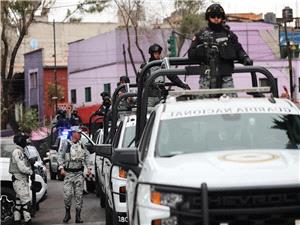
Arya News - El Mencho consolidated Mexico’s most powerful criminal organisations in part due to a unique franchise-based structure.
Monterrey, Mexico – Portraits of the missing cover Guadalajara’s “Roundabout of the Disappeared”, a landmark renamed by families to highlight the state’s disappearance crisis.
On February 22, the streets surrounding the memorial and throughout the city stood empty after the Mexican army killed Ruben Nemesio Oseguera Cervantes, the longtime leader of the Jalisco New Generation Cartel (CJNG).
In retaliation, cartel members set fire to buses and taxis, erecting a series of blockades that spread across 20 states.
The widespread unrest demonstrated the CJNG’s capacity for rapid coordination, fuelled by a ‘franchise’ model that allows smaller cells to operate under the cartel’s brand and vast financial network.
While the group’s economic reach extends into Europe and Asia, its power remains rooted in its paramilitary force. This structure relies on extortion, brutal violence and forced disappearances as its main tools to seize territory and control markets.
Oseguera Cervantes, known as “El Mencho”, consolidated one of Mexico’s most powerful criminal organisations in part due to a unique franchise-based structure.
According to the United States Drug Enforcement Agency (DEA), the CJNG maintains a presence in every state of Mexico, with varying levels of influence, and operates in more than 40 countries across the Americas, Europe, Asia and Africa, and throughout the US. Its primary activity is the trafficking of cocaine, fentanyl and methamphetamine.
Raul Zepeda Gil, a teaching fellow in War Studies at King’s College London, notes that rather than following a “classic organisational pyramid”, the CJNG avoids a centralised financial network.
“Instead, profits can be distributed across many locations and groups simultaneously,” Zepeda told Al Jazeera.
Besides controlling key areas in western Mexico, the CJNG controls the Pacific Coast region, including the strategic ports of Manzanillo and Lazaro Cardenas, crucial for the import of synthetic precursor chemicals.
“Their most important activity is drug trafficking,” Zepeda said. “Chemical precursors that arrive from China reach Mexican ports and are then sent to the United States already in fentanyl form.”
The organisation also generates revenues through fuel theft, illegal mining, extortion, migrant smuggling and money laundering.
On February 19, the US Department of the Treasury’s Office of Foreign Assets Control (OFAC) sanctioned a timeshare fraud network led by the CJNG that targeted elderly Americans.
“Timeshare fraud in Mexico has plagued American victims for decades, costing them hundreds of millions of dollars while enriching criminal organisations such as CJNG,” the Treasury Department stated in a press release.
The CJNG’s extensive reach and rapid growth are made possible by a vast, powerful network that protects drug trafficking operations and ensures impunity, says Carlos Flores, an investigator at the Centre for Research and Higher Education in Social Anthropology (CIESAS). Flores argues that these “hegemonic power networks”, shadow networks of business leaders, politicians, and criminals, have reconfigured state institutions to serve their own interests.
“These same networks, which control and administer state institutions – including security institutions – focus their actions primarily against their competitors, while simultaneously allowing these other networks to consolidate their power,” he added.
The rise of a deadly paramilitary force
Forced disappearances and extortion are crucial for the CJNG’s control of the market, seeding fear that silences communities and facilitates forced recruitment. This ensures a steady supply of disposable labour while following the ‘no body, no crime’ logic that minimises the political and legal costs of their operations.
Homicides and forced disappearances have surged in Jalisco since the group emerged in 2010. The CJNG rose from the remnants of the Milenio Cartel, a subordinate partner of the Sinaloa Cartel based in Oseguera Cervantes’s home state of Michoacan. While across Mexico more than 130,000 people are missing, Jalisco currently ranks at the top with at least 16,000 reported cases, and collectives of families continue to uncover mass graves and what they describe as “extermination sites”.
Raul Servin, a member of the Guerreros Buscadores, a collective representing more than 400 families of the disappeared, told Al Jazeera that their searches frequently reveal human remains in varying states of decay and torture. They have found victims who were shot, hanged or killed with bladed weapons that were left inside the bodies, he said.
“It’s a sadness and helplessness we feel when we see each body these people leave behind,” said Servin, who has been searching for his son since 2018.
Beyond its financial power, the CJNG is notorious for its extensive arsenal of military-grade weaponry, including armed drones, rocket-propelled grenades, and firearms.
On February 22, more than 25 National Guard members were killed in Jalisco. In the past, the organisation has also carried out high-profile attacks against public officials.
Last year in February, US President Donald Trump designated the Jalisco New Generation Cartel as a foreign terrorist organisation. In July, US prosecutors in Virginia unsealed an indictment against Petar Dimitrov Mirchev, a Bulgarian national accused of conspiring with East African associates to equip the CJNG with military-grade weaponry. The indictment states that Mirchev brokered these deals “despite knowing that the CJNG inflicts catastrophic suffering” to protect its prolific drug trafficking operations.
The indictment also revealed that the CJNG was attempting to buy surface-to-air missiles and anti-aircraft systems (ZU-23). Overall, Mirchev allegedly created a list of weaponry worth approximately $58m.
The paramilitary profile has allowed the CJNG to expand rapidly into rival territories and monopolise the market. Flores describes this training, deployment, and weaponry as being similar to an army, making them “practically uncontestable”.
“They operate under a different kind of logic,” Flores said. “They provide a kind of licence to [local] groups that associate with them. They fight their enemies and collaborate on trafficking in exchange for using the Jalisco New Generation Cartel as a label.”
The CJNG adopted a level of brutality similar to Los Zetas, whose founders were elite Mexican special forces soldiers trained by the US and Israel. In its early days, the CJNG was known as the “Matazetas”, or Zetas Killers.
Servin and the Guerreros Buscadores have seen the results of this brutality firsthand. Locating the missing becomes more difficult as concealment tactics evolve, Servin said. Disappearances have become a powerful economic tool to control and exploit territory. Collectives often find bodies buried under layers of dirt and animal carcasses to throw off the scent, or even encased in concrete.
“They make us work harder than necessary. If they took his life, why not leave him where we can find him quickly?”
Zepeda says that the CJNG leveraged military-grade tactics to fill the void left by the government’s crackdown on other cartels carried out between 2008 and 2010. In 2009, the Beltran-Leyva Organisation – which had been at war with the Sinaloa Cartel since their 2008 split – was reeling from a series of high-profile arrests and killings.
The death of Ignacio “Nacho” Coronel, a key finance operator for the Sinaloa Cartel, at the hands of the military in 2010 further cleared the way for new criminal players. Oseguera Cervantes was working under Coronel before breaking away to form what would become the CJNG.
“If we could summarise the Jalisco New Generation Cartel, it’s a reinvention of Los Zetas, which took over all the territory that the other cartels defeated by the Mexican government had occupied,” Zepeda added.
This history serves as a warning of what may follow the death of Oseguera Cervantes. Zepeda pointed out that the drug trade is an incredibly dynamic market where “there will always be a group of people willing to take control”.
Flores warns that “decapitating the leadership” is insufficient if power networks, along with the CJNG’s criminal and operational structures, remain intact.
“Without dismantling the power networks, yesterday’s victory will become the cause of new violence tomorrow,” Flores said. “We’ve seen this approach many times before, and we know what it leads to: It solves neither the transnational drug problem nor creates conditions of greater stability for the Mexican population.”