Arya News - By Krisztina Than SALGOTARJAN, Hungary, Feb 26 (Reuters) - Hungary`s upcoming election is about whether it can cement its place as a European nation and revive its stagnating economy with crucial EU
By Krisztina Than
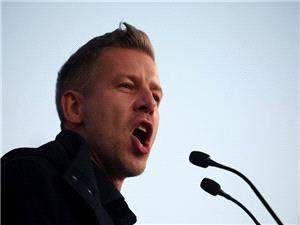
SALGOTARJAN, Hungary, Feb 26 (Reuters) - Hungary"s upcoming election is about whether it can cement its place as a European nation and revive its stagnating economy with crucial EU funds or drift eastwards into the authoritarian camp, opposition leader Peter Magyar told Reuters.
In the April 12 vote, Magyar"s centre-right Tisza party poses the most serious threat to nationalist Prime Minister Viktor Orban"s 16-year grip on power and to his vaunted brand of what he calls "illiberal democracy".
The election will also be a test for Europe"s far-right forces as the EU struggles to deal with a more assertive Russia, the war in Ukraine, and the diplomatic and economic challenges of Donald Trump"s "Make America Great Again" presidency.
Magyar, speaking on the campaign trail, took aim at Orban"s warm ties with Russia and other former Soviet republics such as Kazakhstan and Azerbaijan, and his decision to secure observer status for Hungary in the Organisation of Turkic States.
"This will be a referendum: I think it is clear that the choice is between Europe or the Turkic council and dictators," Magyar said in an interview in Salgotarjan, a former mining town, after a rally that attracted hundreds in frosty weather.
"It is about whether Hungary continues these 16 years of decline ... or we set off to Europe and development, joining the Poles, Slovenians, Czechs and the Baltic states."
Orban has cast Hungary as a bridge between "Eastern traditions and Western institutions" and says it must be pragmatic in pursuing its economic interests.
UNFREEZING EU FUNDS
Magyar, whose Tisza has widened its lead over Orban"s Fidesz according to the latest poll, said that his party, if elected, would clinch a deal with Brussels to unlock funds suspended under the EU"s Recovery and Resilience Facility (RRF) scheme over Orban"s rule-of-law reforms as well as cohesion funds to finance infrastructure.
The deadline for accessing the RRF funds is the end of August or they get lost. Magyar said his government would act swiftly to meet the rule-of-law conditions for their release.
"I very much hope that we will be able to sign a deal quickly and after an agreement in principle, perhaps even before the legislation is approved, they can start disbursing the funds," he said.
Hungary has a total of about 17 billion euros of EU funds frozen because of non-compliance with rule-of-law principles under Orban. The bulk is under the RRF scheme, where Hungary has almost 11 billion euros still available.
The forint currency has firmed recently partly in anticipation of a possible Tisza win and the release of EU funds, analysts say.
NEED TO WORK WITH TRUMP ADMINISTRATION
Magyar said his government would seek "constructive and friendly" relations with the United States.
"Europe is in a very difficult situation economically, socially and in security policy, so we must work together with the Trump administration ... and I will seek the same," he said.
Trump has personally endorsed Orban in the April election as "a truly strong and powerful Leader", while Secretary of State Marco Rubio has said U.S. ties with Hungary under Orban are entering a "golden era".
On Ukraine, Magyar said he was hopeful that a ceasefire could be reached "perhaps even before the Hungarian elections" followed by a long-term peace deal backed up by international security guarantees for Kyiv.
The Trump administration has been mediating in peace talks between Moscow and Kyiv but there are currently no signs of an end to the four-year war.
Orban has cast Hungary"s election as a stark choice between "war or peace", saying Tisza would drag the country into the Ukraine conflict, a message reinforced on state TV, which is under government control, but rejected by Magyar"s party.
Magyar reiterated that a Tisza government would not send troops or weapons to Ukraine but "would support the peace process".
(Reporting by Krisztina Than and Krisztina Fenyo, additional reporting by Jan Strupczewski in Brussels, Editing by Gareth Jones)