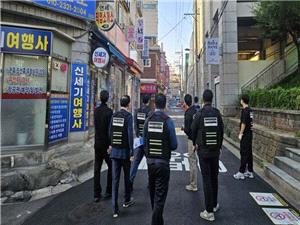
Arya News - As immigration raids intensify, migrant workers describe injuries, family separation, and the contradictions of Korea`s labour system.
SEOUL – Faisal, a 42-year-old man who came to Korea well over two decades ago, could never forget the night his friend was badly injured during an immigration crackdown in Hwaseong, Gyeonggi Province.
“My friend fell from the second floor,” he said. “His arm was broken as he tried to escape from the officers.”
He said immigration officers now conduct crackdowns around his workplace about every one to two months, with the most recent raid occurring in January. The operations, he added, increasingly take place in nonwork settings, including subway stations and local markets.
Faisal came to South Korea on a D-4 language study visa nearly 20 years ago, and worked on the side. He said he overstayed after his employer urged him to remain in the country.
“My boss told me, ‘Don’t go home. Just stay because you work well,"” he said. “I also wanted to stay because I wanted to earn more money.”
Faisal, who agreed to speak under a name for fear of retaliation, said he has been caught several times by immigration.
He compared Korea’s recent enforcement to operations in the United States, in that officers here often appear without warning and sometimes in plain clothes, leaving workers not knowing who is approaching.
“When people run away and are caught again, some officers beat them and kick them,” he said.
Workers taken into custody are transferred to immigration offices, where they wait to be processed for deportation, he said. Migrant workers in his area warn one another when officers are spotted.
“Before, raids happened maybe once a year and felt more like a formality,” said Shek al Mamun, a director who first came to the country as a migrant worker. “Since the Yoon Suk Yeol administration, crackdowns have become much more frequent.”
The Yoon administration adopted a policy of expanded visa provision, especially for manual workers, alongside stricter enforcement, citing an increase in illegal immigration under the previous Moon Jae-in administration.
The number of people in Korea staying illegally rose 75 percent during Moon’s term, with those entering on student and tourist visas accounting for most of the increase.
Mamun, 52, who is a naturalized Korean citizen and campaigns for migrant rights, said that authorities previously refrained from full-scale operations, despite knowing where foreign nationals lived and worked illegally.
Now, he said, the Ministry of Justice operates a specialized immigration enforcement team dedicated to crackdowns.
Mamun also accused the immigration authorities of neglecting due process, including providing interpretation and identifying themselves.
The Ministry of Justice did not reply to The Korea Herald’s inquiry about the accusations.
However, the National Human Rights Commission of Korea called for more transparency in immigration crackdowns, advising the National Police Agency in October that it should implement a process deliberating whether arrest is necessary before taking over a case from immigration authorities.
Justice Ministry data shows that almost 140,000 foreign nationals were either deported, fined or issued a departure order in 2024. The number has steadily risen from 98,000 in 2022.
As raids grow more frequent, Faisal said it is only a matter of time before he is detained.
“I always have to be ready. I could be caught this month,” he said. “It’s scary. I keep myself and my family prepared.”
Living without legal status
Faisal is the father of two young children, and living without legal status has made even basic care difficult.
“When I take them to the hospital, it’s very expensive because I can’t provide them with medical insurance,” he said. He added that he worries about their education as they grow older.
“I’m afraid they’ll arrest me when I’m with my children,” he said. “Then I wouldn’t be able to care for them at all.”
He added that his immigration status makes it nearly impossible to report workplace abuse, harassment or violence. “You just endure it,” he said. “If you speak up, you risk being reported.”
Faisal said it had been 26 years since he visited his home Bangladesh.
“I don’t remember what my home looks like anymore,” he said. “It saddens me to see during video calls that my parents’ hair turned white.”
A structural contradiction?
Mamun said cases like Faisal’s reflect a deeper structural problem in Korea’s immigration system.
“Sometimes Korea issues visas permitting foreigners to stay in the country, but bars them from finding work,” he said, noting also the case of international students, who face limits in the type and amount of work they can do.
“They trap them in a mold made by the Justice Ministry and then fine or deport them when they work to make a livelihood.”
He said the Ministry of Justice knows that students must work to fund their education and lead a life in Korea, but turns a blind eye to their needs. He alleged that the government has been bringing in students to “fill the seats” in universities on the brink of closure.
“Korea issues visas easily, brings in foreigners, makes them illegal, then collects fines, and then sends them back when they are no longer needed,” Mamun added. “This is worse than the system in the US.”
Mamun said this was also the case for seasonal migrant workers. He criticized the Justice Ministry of failing to find solutions for a crumbling policy.
“The government should know by now that this doesn’t work and that foreign workers run away due to structural problems,” he said. “But they don’t bother to change the root cause.”
Under Korea’s employment permit and trainee systems, many migrant workers are allowed to remain in the country only for a limited period, even when employers want to retain them. Changing workplaces or extending stays is restricted, and long-term settlement options are scarce.
“As a result, many workers overstay not because they want to break the law, but because the system gives them no other choice,” Mamun said.
These workers face heavy fines, detention and deportation, despite having filled labor shortages for years. Legal experts acknowledge there are structural limits that incentivize workers to overstay their visas.
“(Seasonal workers) usually use brokers to obtain their jobs because there is a shortage of public workers who operate the program,” said Park Bum-il, an attorney at law firm Global and an expert in immigration law.
According to Park, hiring a broker can cost up to 3 million won ($2,100), while seasonal workers are only allowed to stay in Korea for up to three months, making a maximum 7 million to 8 million won. “That makes them overstay their visas.”
Park also pointed to the work culture in Korea’s immigration office that sees maximizing enforcement actions as an accomplishment.
“I think immigration officers have the most discretion among Korean bureaucrats,” Park said. “But, they are weary of using it in case of an audit.”
Meanwhile, Mamun alleged that the system benefits from cheap foreign labor when it needs workers. “Then it criminalizes them for staying.”
The activist noted that foreign nationals who are in Korea without permission typically enter the country legally. He said this points to the fact that there is a structural flaw in how Korea issues visas and manages its foreign workforce.
Park agreed: “We are surrounded by water. It is difficult to enter illegally.”
But he said that in other respects, the situation in Korea was not strikingly different from elsewhere.
“No country allows seasonal workers to work without a limit,” he added. “If that was the case, they would all chase high-earning jobs, and places that really need labor would not be able to obtain it.”
To Park, the real problem is that Korea’s immigration laws are too rigid and strictly enforced.
“Students invest over 10 million won to study in Korea. There should be more leeway to help them better settle here.”
He also pointed out that immigration officers often restrict entry to travelers from less developed countries, even if they come with legitimate paperwork.
Those from Thailand face particular skepticism from officials because of the number who overstay after entering on the tourist visa waiver program.
“Korea got international complaints after it restricted access to people from countries like Thailand and Mongolia, regardless of whether they had the appropriate paperwork or not.”
For Faisal, this system is something he lives with every day.
“I really like this country. I like its people and food, and I am even willing to pay the taxes,” said Faisal. “I would be really thankful if they let me live legally.”