Arya News - The case is the first major challenge to Trump’s policy agenda, but the US president still has other legal avenues to pursue trade restrictions.
The United States Supreme Court has ruled that President Donald Trump’s global tariffs are illegal.
In a 6–3 decision written by conservative Chief Justice John Roberts, the court agreed that Trump exceeded his authority by invoking a 1977 law to impose the tariffs.
Recommended Stories
list of 2 items list 1 of 2 Why did the US Supreme Court strike down Trump’s global tariff policy? list 2 of 2 Trump: Supreme Court’s rejection of tariffs ‘deeply disappointing’ end of list The case is the first major challenge to Trump’s policy agenda before a court he reshaped by appointing three conservative justices during his first term.
Trump called the ruling “a disgrace”. The court remanded the case to the US Court of International Trade (CIT) to oversee a refund process .
Here is what we know:
What has the Supreme Court decided?
The court ruled that the International Emergency Economic Powers Act (IEEPA) does not give the president the power to unilaterally impose sweeping tariffs.
“Our task today is to decide only whether the power to ‘regulate … importation,’ as granted to the president in IEEPA, embraces the power to impose tariffs. It does not,” Roberts wrote in the ruling.
In its decision, the justices said the 1977 law was designed to allow presidents to respond to specific national emergencies, such as freezing assets or blocking transactions, but not to overhaul US trade policy through broad, across-the-board tariffs.
The majority concluded that using IEEPA in this way went beyond the authority Congress intended to grant.
“What it means first and foremost is that Donald Trump acted illegally. He was breaking the law,” Chris Edelson, a lecturer at the University of Massachusetts Amherst, told Al Jazeera.
“Donald Trump said the emergency law allowed him to use tariffs and the Supreme Court said, ‘Actually, Congress didn’t say that,’” he added.
What was Trump’s legal reason for imposing tariffs in 2025?
Trump argued that the tariffs were justified under the IEEPA, saying the US faced six national emergencies.
He described the long-running US trade deficit, which the country has recorded every year since 1975, as one national emergency that threatened economic security.
He also cited the surge in overdoses linked to the powerful opioid fentanyl, arguing that the flow of the drug into the US constituted a separate national emergency requiring executive action.
In the end, the case he presented centred on two tariff groups.
One set was imposed on nearly every country, with Trump arguing they were necessary to address persistent US trade deficits.
The other targeted Mexico, Canada and China, which he said were responsible for the flow of illegal fentanyl into the US.
How much money is at stake?
The Trump administration has not released tariff collection data since December 14.
However, Michael Pearce, chief US economist at Oxford Economics, estimates that more than $130bn in tariffs have already been collected under the emergency declarations.
He said the ruling is likely to trigger a prolonged legal battle over whether that money must be refunded.
“What happens? Do they get this money back? The companies are going to want it back. I don’t know how that’s going to work,” Edelson said.
Which judges dissented against the ruling?
Three conservative justices, Clarence Thomas, Samuel Alito and Brett Kavanaugh, opposed the decision.
They wrote that the ruling did not necessarily foreclose Trump “from imposing most if not all of these same sorts of tariffs under other statutory authorities”.
“In essence, the court today concludes that the president checked the wrong statutory box by relying on IEEPA rather than another statute to impose these tariffs,” Kavanaugh wrote.
Justices Neil Gorsuch and Amy Coney Barrett, both appointed by Trump during his first term, joined Chief Justice Roberts’s majority opinion in full.
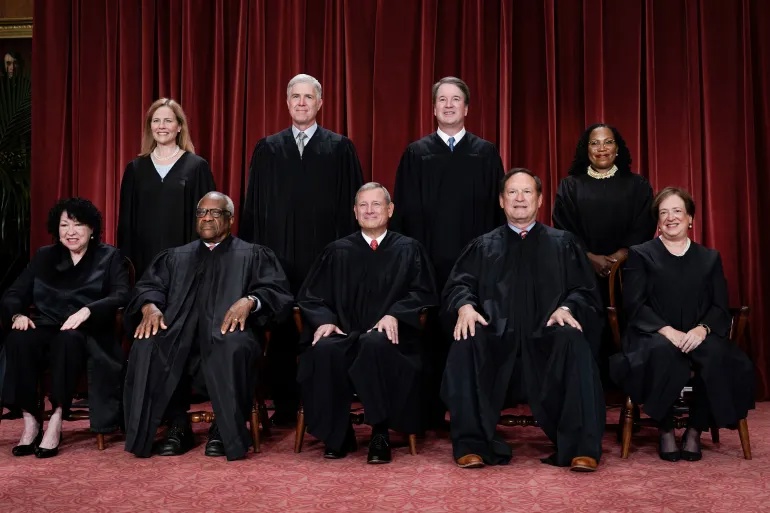
Members of the Supreme Court sit for a new group portrait at the Supreme Court building in Washington [File: J Scott Applewhite/AP Photo] Can Trump still impose tariffs after the Supreme Court ruling?
The president still has other legal avenues to pursue trade restrictions.
One option is Section 232 of the Trade Expansion Act of 1962, which allows tariffs on national security grounds. This authority was used during Trump’s first term to impose tariffs on steel and aluminium imports.
Another is Section 301 of the Trade Act of 1974, which permits the US to impose tariffs in response to unfair trade practices by other countries.
This was the legal basis for many of the tariffs placed on China during Trump’s earlier trade disputes.
He could also pursue more targeted trade actions through existing anti-dumping and countervailing duty laws.
What was Trump’s reaction?
Trump criticised the ruling, arguing that presidents should have sweeping trade authority.
“I can destroy the trade, can destroy the country. I can do anything I want,” he said.
He complained that while he could impose an embargo, the court’s interpretation meant he could not even “charge $1″.
“How ridiculous is that?” he said.
Trump also praised Justice Brett Kavanaugh ’s dissent, saying it suggested he could rely on other legal authorities in the future.
“He’s right,” Trump said. “In fact, I can charge much more than I was charging.”
Why does this ruling matter?
Beyond Trump’s specific tariffs, the ruling could influence how future presidents deploy emergency powers, potentially narrowing the scope for unilateral action.
“The Supreme Court will follow the law, and that doesn’t mean that Donald Trump will get a blank cheque to do whatever he wants,” Al Jazeera’s Alan Fisher said, reporting from Washington, DC.
Bruce Fein, a former US associate deputy attorney general and constitutional lawyer, described the ruling as a “clear signal” that the president does not have unlimited unilateral authority.